


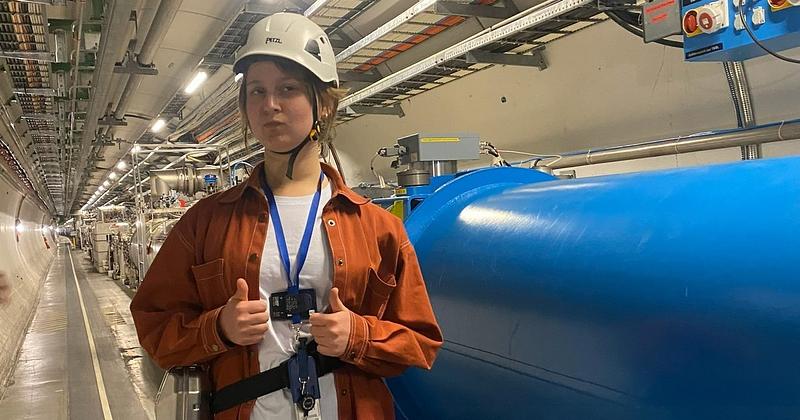
I was lucky enough to visit the Large Hadron Collider.” A SoftServe engineer on her internship at CERN
Olha Rybenchuk is a Junior Robotics Engineer at SoftServe. Recently, she completed an internship at CERN in Geneva — the European Organization for Nuclear Research — where she had the opportunity to inspect the Large Hadron Collider.
In the interview, Olha talks about how she secured an internship at CERN, what the collider is like from the inside, and how this experience influenced her perception of robotics.
“One of the projects involved a robotic arm.” How I got an internship
I have been working at SoftServe since June 2023 while pursuing a master’s degree in robotics at Lviv Polytechnic National University. During the bachelor’s program, we studied algorithms, electronics, data collection and processing, cloud integrations, and software architecture. Although it was not pure robotics, this foundation gave me a solid basis for further development.
Student projects also played an important role. Already in the first year, we formed a team that worked with mentor Vasyl Rybak, a Robotics specialist at SoftServe. He has extensive experience in projects involving robotic manipulators and drones, and it was he who proposed the idea for a student project — autonomous drone delivery to hard-to-reach locations.
As a student, I constantly look for opportunities specifically available to students — those that provide hands-on practice and additional experience. In the spring of 2024, I applied to several summer internship programs, including CERN.
For a long time, I did not receive any response. Only at the end of August did my future supervisor contact me and invite me to an interview.
The process itself consisted of two interviews. The first was combined — partly technical and partly general. I spoke in detail about my technical experience, the technologies I have used, what I have worked with, and my experience in studies, student projects, and pet projects.
At the same time, the supervisor was telling me about the projects they currently had and asking which ones interested me most. Among them were:
- projects focused on collider inspection;
- optimization and planning of trajectories for a robot’s return to a charging station;
- sensor fusion — combining data from cameras, LiDAR, and other sensors to build a map of the environment.
One of the projects involved a robotic manipulator — a robotic arm — and its integration with the Unitree B2 quadruped robot. This system was intended for inspecting the facilities of the Large Hadron Collider. That was the option I chose.
The second interview was more organizational in nature. It covered administrative matters such as the internship duration, possible dates, the work format, whether it could be counted as a bachelor’s thesis, and other non-technical but important questions.
As a result, I was accepted into the program. I don’t know how competitive the selection was — CERN does not disclose this information. However, there were many students. The largest group was in robotics — up to 18 people could be working in the office at once. In theoretical physics, distributed computing, or machine learning, there were fewer students, but more researchers with higher academic qualifications.
In practice, the project at CERN became my diploma thesis for Lviv Polytechnic.
“I expected to see extremely strict scientists.” Relocation and the start of the internship
My internship was scheduled to start only in February 2025, as before that I needed to finish a project at SoftServe before taking a sabbatical, coordinate everything with Lviv Polytechnic, formalize the agreement between the university and CERN, and resolve visa-related matters.
In general, internships at CERN last up to six months. I chose a four-month term so that I could defend my bachelor’s thesis in June.
The relocation effectively began back home in Lviv. First of all, I had to find housing while also dealing with visa arrangements. CERN helped with many organizational aspects: they issued an official invitation and guided me through the process of obtaining a diplomatic visa.
An interesting detail is that CERN is located on the territory of two countries at once — France and Switzerland. Accordingly, it was possible to choose which visa to apply for: French or Swiss. This also influenced the choice of housing. A French visa allows you to live and stay in both France and Switzerland, while a Swiss visa allows you to stay only in Switzerland. In other words, the visa affected rental prices and commuting time.
There is no visa fee — CERN covers the cost. The only thing you pay for yourself is traveling to the place where you submit your documents. A French visa can be obtained in Kyiv, while a Swiss one must be obtained in Romania. The processing time for both is about ten days. So it was obvious that I opted for a French visa.
CERN has two dormitories: one on the Swiss side and another in a nearby French town. I lived in one of them for some time. The living conditions are decent, and a free shuttle runs every hour directly to my office.
However, renting an apartment is more comfortable — it is often cheaper if you share it with someone, you can host friends and relatives, and commuting is usually more convenient. But to find an apartment, you have to constantly monitor all possible housing platforms, call landlords, and “compete” with other interns. After going through all these stages, two students from Ukraine who were also interning under the program and I eventually managed to find a place to live.
By the way, CERN does not cover housing, transportation, or food expenses. For example, even accommodation in the dormitories was paid, about €650 per month.
The contract provides only monthly payments. Under my internship type, the Short-Term Internship, the stipend was about 1,400–1,500 Swiss francs. There are other types of contracts with higher payments.
This amount was enough for my basic needs, but for a more active lifestyle, I partly relied on my savings — I wanted to go to the mountains and ski. After all, being in Switzerland and not going to the mountains would be a sin.

At CERN, all contracts start on the first day of the month. On that day, a welcome session is held — a large introductory presentation. Representatives from HR, engineers, and scientists take part, explaining how everything works at CERN.
All of this takes place in the famous Globe of Science and Innovation — a large wooden structure on the CERN site that serves as a presentation hall. It’s also an opportunity to meet other students, mentors, and CERN staff. The environment is extremely international — people from dozens of countries, with very diverse backgrounds.
I was a bit nervous. CERN is a research center. It sounds dire, and I expected to see rigorous scientists — the kind you’d be afraid even to start a conversation with. No small talk at all. But the reality turned out to be completely different.
After the introductory part, I came to the intern office for the first time. All the students there were roughly my age, with similar experience. The atmosphere was very lively and open. Almost everyone had their own individual project. You could walk up to anyone and ask what they were working on.

I was fortunate with my mentor. He has vast experience and many projects under his belt, yet he always finds time to help.
Already in the first days, he gave me a tour of their robotics laboratory. It’s a large workshop where all the robots used at CERN are tested. There are many different systems there — both ready-made commercial solutions and robots developed directly at CERN.
In the same space, there is a prototype of part of the Large Hadron Collider, used for testing code before it is deployed in the real environment.
“Even cows were grazing nearby.” What a typical internship day looked like
I usually woke up at 7 a.m. In general, I tried to align my schedule with when the other students got up, so I wouldn’t arrive at the office alone — working that way felt a bit lonely. I took a bus and spent about 20 minutes getting to the office.
There was a coffee machine in the office and a table with snacks. I always brought Kinder Bueno — it became my little local tradition. During the first hour, we usually just talked: discussed philosophical topics, politics, and everyday things. Only after that did I sit down to work.
The first two months of the internship were a full immersion. I was figuring out how CERN’s internal framework works, how to retrieve data from the robotic arm, and how it all connects. I was constantly looking things up: if I didn’t know something, I asked either my supervisor or other students who already had experience with it.
At noon — lunch. Some people brought food from home, and others went to the cafeteria. If the weather was good, you could sit outside and watch herds of deer or roe deer running nearby. There were also lots of birds around. Even cows were grazing close by.

Then it was coffee again, more work, and around 5–6 p.m. I headed home. After work, it was either the gym or other activities with fellow students. Weekends were usually very active. CERN is located outside the city, in the Meyrin area, and it takes about 40 minutes to get to downtown Geneva.
On weekends, we often went to Lake Geneva, went hiking, or explored nearby places like Salève, Carouge, and the surrounding mountains. If someone had a car, we could go skiing. Overall, weekends were packed with activities.
“I added a robot dog to the simulation.” About the project
The project I worked on throughout my internship was called “Integration of a robotic manipulator with a quadruped robot for the inspection of the Large Hadron Collider caverns.” That’s more of a general title. In more practical terms, the core of my work focused on developing an interface library for a robotic arm.
This involved integrating the robotic arm into CERN’s internal framework. That framework already includes its own solvers and trajectory generators — modules that define how a robot should move. My task was to implement the part that acts as an interface between the physical robot and this framework.
I read the robot’s current position, passed this data to the framework, and in return received the next target point or a motion trajectory. After that, I could instruct the system, for example: “I want to move to this point,” and the trajectory would be generated accordingly.
It was a basic system that made it possible to later use this robotic arm together with a quadruped robot. At the hardware level, I worked directly with the robotic arm, and the next stage of my research moved into the simulation domain.

I added the quadruped robot itself to the simulation, mounted a robotic arm model on it, and started working with the existing manipulator control module. In the simulation, I moved the robotic arm while applying different loads—for example, a 5 kg payload. I analyzed how this affected the center of mass of the entire system and whether it remained stable.
Based on this data, it was possible to conclude, for example, whether the robotic arm should be mounted strictly at the center of the platform or shifted closer to the front or rear of the robot. In other words, it was an analysis of the stability of the entire “quadruped robot + manipulator” system across different configurations and load conditions.

Outside the simulation, I worked only with the robotic arm. The robot dog itself was physically located in the laboratory. It had been purchased from a Chinese manufacturer, but the manufacturer did not provide the interface cable. The robot could be operated via a remote controller, but it could not be controlled via software or integrated.
After prolonged communication with the manufacturer, the cable eventually arrived — but only after my contract had already ended. As a result, I had to work exclusively in simulation.
Even if the cable had been available at the time, it would have been unlikely to complete the project within four months. Most likely, this part would have been handed over to other interns, who would then work on a separate communication module for the robot dog and trajectory generation directly on the real robot.
In my simulation, the robot dog essentially functioned as a static platform. That is, I did not model its full motion, but analyzed the system in a static configuration.
For my work, I was provided with a powerful desktop computer for resource-intensive tasks and a laptop that I could take into the laboratory to test how the real robotic arm executed trajectories.
If there had been a real need for any additional equipment and it was justified from a project perspective, such items could have been purchased. However, I never encountered such a need.
“I remember sections with radiation warning signs.” About the Large Hadron Collider
I was lucky enough to visit the Large Hadron Collider itself. To get access, you have to complete special training and obtain certification. You are allowed to go down only during periods when the collider is not operating.
Formally, as an intern, I had no obligation to go underground at all. However, my supervisor allowed me to complete the required training and descend to the collider itself — essentially to the heart of the research center. While there, I even helped other robotics specialists a bit during the installation or replacement of robots or individual components.
The training sessions are quite serious. One of them involves oxygen mask training. In the event of an emergency, you have about 40 seconds to put on the mask.
They also explain what to do if an alarm goes off — where to run, how to navigate the tunnels, and where the nearest evacuation exit is located. After all, the Large Hadron Collider is a 27-kilometer structure located about 80 meters underground, and in such conditions, it’s crucial to understand which direction to move quickly.
“Fortunately, all of these instructions are rarely needed in practice.”
If we talk about what the collider looks like from the inside, it’s impressive. I remember sections with radiation warning signs. There are also areas with detectors where particles collide and decay. Everything looks very technical and, at the same time, massive.
Another fun fact: both now and in the past, bicycles have been used to inspect the collider tunnels. Walking all 27 kilometers is difficult, so there are special, slightly lowered bicycles for this purpose.
Specialists are told to go to a specific point and check or replace something — and they ride there on a bike. It’s like an underground cycling track with no pedestrians.
To be honest, I don’t even know whether the traffic there is on the right or left. I don’t think it really matters. If you wanted to, you could probably organize bike races down there.

“The center fundamentally does not engage in military or defense-related developments.” How CERN operates
CERN is, first and foremost, a research center, and this logic shapes everything — from the types of contracts to future employment opportunities. Almost all contracts here are fixed-term. Even long-term ones — for example, four-year contracts — do not guarantee renewal.
After a contract ends, a person either moves on or looks for a new position, but there are no automatic transitions or “career ladders” in the classic corporate sense.
Permanent positions at CERN do exist, but getting one is extremely difficult. These are rare roles with very high requirements, and they are usually held by people who have worked at the center for many years and know its internal processes inside out. There are employees at CERN who have worked there for decades — simply because someone has to preserve institutional memory, expertise, and a deep understanding of how everything works internally.
After my contract ended, there was formally an option to apply for other programs, but they are, again, student positions. After a Short-Term Internship, you can apply for a Technical Student position, then for a Graduate Student role. But each step is a new competition, with no guarantees of continuation.
The core focus of the center’s work is theoretical physics: the study of elementary particles that make up the Universe and the fundamental laws of nature. Another major area is medicine — in particular, research into how radiation affects material properties and how this knowledge can be applied in medical contexts, including cancer treatment.
At the same time, the center fundamentally does not engage in military or defense-related research. This is not a decision made by individual teams — it is enshrined in the organization’s statutes. CERN positions itself as a purely scientific and diplomatic institution.
“Robotics stops being an abstraction.” What CERN gives an engineer
Working at CERN profoundly changes your engineering approach. The logic of work there is structured differently. If you have a clearly defined goal, you are essentially free to choose the methods by which you achieve it.
The key things are a willingness to learn something new, to understand how systems work, and not to be afraid to ask questions. During my internship, I worked with a simulator that was completely new to me, and I was able to transfer this experience directly into my current work.
Working with real robots provides a much deeper understanding of how to interpret data and use it for control and decision-making correctly. It fosters a form of systems engineering thinking that is difficult to develop through theory alone.

Before my internship at CERN, I had no experience in writing scientific papers. It was my supervisor who helped me understand what a serious thesis or research project actually looks like: how to structure it, which tools to use, how to present results, and how the entire research process works in practice.
This experience also changed my attitude toward reading scientific papers — I now better understand how they are written and how to analyze them correctly.
From the very beginning, the program is focused purely on practice. Students are expected to have either a very strong theoretical background — for example, in algorithms or specific technologies — or solid hands-on experience. Without a technical foundation and real-world experience, it is simply impossible to work there.
“No one teaches you ‘from scratch’.”
At the same time, knowledge of a specific platform or this particular simulator was not required — what mattered more was general engineering thinking and the ability to adapt quickly.
My perspective on robotics in general also changed. Having access to a large number of physical robots makes you realize that you don’t always need to build everything from scratch. Often, it is more effective to develop solutions based on existing platforms, adapting them to specific tasks.
At CERN, most robots are used to inspect the Large Hadron Collider during periods when it is operating, and human presence is dangerous due to radiation. When you see robots genuinely replacing humans in high-risk environments, robotics stops being an abstraction.
This experience also has practical applications beyond CERN. It’s not limited to nuclear facilities or “exclusion zones,” but also extends to industrial environments. Working in conditions involving radiation, strong magnetic fields, and unusual physical constraints is a specialized expertise that can be critically valuable across many industries.
 0
0




 0
0