



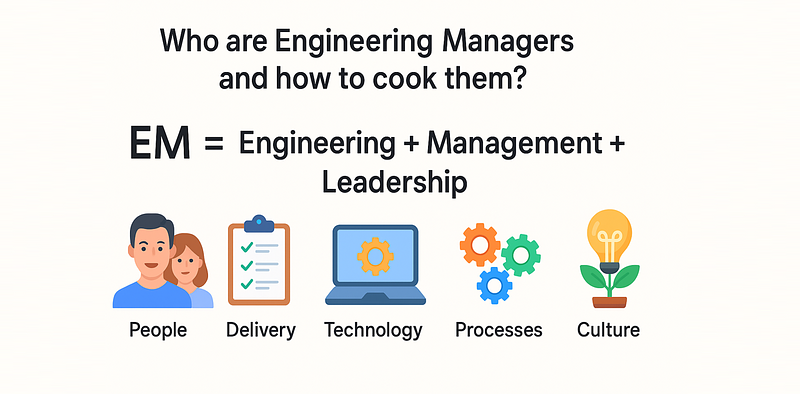
Who are Engineering Managers and how to cook them?
We often see positions such as Engineering Manager or Senior Engineering Manager in software development companies. At the same time, some companies, especially those with small teams, do not have such a position at all, yet still manage to achieve their goals effectively. So who exactly is an Engineering Manager? What do they do, and does a team actually need one?
First, it’s important to understand that manager is a job title, position, but in addition to positions, there is also the concept of roles. Development organizations have many roles, and depending on workload and team size, the company structure may assign each role to a separate position or a single position may combine multiple roles. There is no strict rule defining which role must correspond to which title; this highly depends on how the organization is structured.
So, which roles are typical for an Engineering Manager, and what does each of them include?
1. People Manager
This is the first and perhaps the most important role for any manager — being the leader of the team.
As part of this role, the manager:
- Leads the hiring process: defines team needs, participates in interviews (whether technical or soft-skill focused — both are equally important), and makes the final hiring decisions.
- Oversees onboarding: ensures fast adaptation of newcomers, assigns mentors, and monitors progress to make sure new hires running effectively.
- Provide a performance management: holds regular 1:1s, sets individual goals, reviews performance, and supports ongoing growth and development of each team member.
- Coaches and develops the team: helps build personal development plans, improve soft & hard skills, and supports career growth.
- Resolves conflicts: a key function of a manager is maintaining a healthy team atmosphere, which requires noticing and addressing problems before they escalate.
- Retains and motivates the team: includes preventing burnout, ensuring fair workload distribution, and maintaining engagement.
Of course, managers are supported by other specialists and departments (HR, People Partners, Tech Leads), but each of them sees only a part of the picture. The Engineering Manager is the one who brings all these perspectives together and holds the complete overview.
2. Delivery Manager / Team Lead
This is the second most important role — delivery ownership. An Engineering Manager is responsible for ensuring that the team consistently meets the commitments expected by the business.
Key functions in this role:
- Work planning: participating in sprint planning, release planning, and defining team priorities.
- Building and maintaining workflows: implementing an effective development cycle (Scrum, Kanban, or hybrid processes depending on team needs), eliminating bottlenecks, and continuously refining processes.
- Execution control: tracking task status, understanding risks, and reacting to them in time (often requiring additional communication or process adjustments).
- Delivery assurance: ensuring quality of results and meeting deadlines.
- Transparency and communication: synchronizing with product managers, designers, and other teams; ensuring the business always has a clear understanding of the team’s status.
3. Engineering Excellence Driver / Technical Leader
This role is optional for Engineering Managers, and is more typical in smaller teams (or rather, in small teams Tech Leads often turns into Engineering Managers). In many companies, Engineering Managers no longer write code or directly participate in implementation, but they must possess enough technical competence to guide the engineering direction, understand the team’s challenges, and communicate effectively both upwards and downwards.
Responsibilities within this role:
- Technical direction: defining technical strategy, architectural approaches, standards, and other engineering guidelines.
- Code quality & practices: overseeing engineering discipline, CI/CD, testing approaches, and sometimes code quality.
- Technical ownership: ensuring overall product health — availability, stability, scalability, technical debt, and more.
- Technical decision-making: participating in design reviews and evaluating technical proposals (RFCs, ADRs).
- Mentoring the Tech Lead: if the team has a Tech Lead, the Engineering Manager helps them grow both the team and the processes.
4. Process Architect
This is a mandatory and ongoing role for the Engineering Manager - continuously improving operational efficiency and team workflows.
This role is much like studying in university: during the first years, you work hard for your grades, and later those grades work for you. If you invest effort early into building efficient, high-quality workflows, future work becomes much easier — you can shift more attention to product-related matters because the team functions like a reliable machine. Otherwise, your time will constantly be consumed by manual micromanagement and firefighting.
Core functions:
- Process assessment: identifying bottlenecks and optimizing communication and workflow patterns.
- Implementing best practices: code reviews, CI/CD, DevOps principles, quality gates.
- Automation: eliminating manual or repetitive tasks.
- Retrospectives: creating a psychologically safe environment where the team can openly share issues and improve work processes.
5. Culture & Community Builder
An Engineering Manager shapes the team’s culture and creates an environment where engineers enjoy their work.
Key functions:
- Building engineering culture: openness, accountability, initiative, craftsmanship.
- Strengthening team cohesion: team activities, rituals, internal tech talks, celebrating small and large wins, sharing team and individual achievements.
- Establishing behavioral standards: addressing toxicity and maintaining psychological safety.
- Contributing to the broader tech community: building internal guilds, organizing and participating in tech talks, knowledge sharing, and more.
Additional Roles (Sometimes Assigned, but Not Recommended): Product Owner
Sometimes Engineering Managers are assigned additional roles that do not naturally belong to the position. One example is the role of Product Owner.
Combining the roles of Engineering Manager and Product Owner is usually discouraged because it may significantly degrade process quality.
- Product Owner/Product Manager is responsible for what we build — user needs, feature value, prioritization.
- Engineering Manager is responsible for how we deliver — team, technical quality, processes, delivery.
Tasks of a Product Owner that typically do not belong to an Engineering Manager:
- Market and user research
- Feature backlog creation
- Feature prioritization
- Writing acceptance criteria
- Release scheduling
- Managing product/business goals
In small companies without a dedicated Product Owner, the Engineering Manager may write user stories, prioritize work, maintain the backlog, and act as a “proxy PO.”
In technical teams without a direct product (internal platforms, infrastructure teams, developer productivity teams, system APIs), there may be no Product Owner at all, so the Engineering Manager often acts as a Technical Product Owner.
There are also rare hybrid roles like EM/PM hybrid, but these are exceptions rather than a norm.
Conclusion
An Engineering Manager is a leader who is simultaneously responsible for people, engineering quality, and results. They ensure hiring and development of the team, engineering excellence, and consistent delivery. They are also key partners to product managers and architectural drivers of scalable, high-quality technology products.
Sincerely yours, Oleh Sych
 0
0



 0
0