


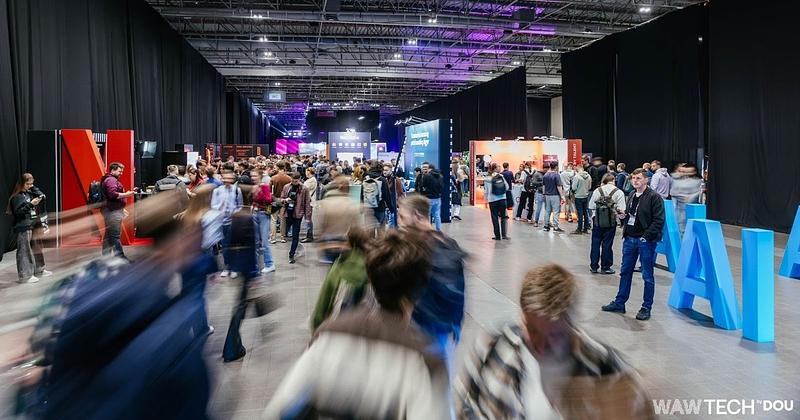
What WAWTech 2025 Was Like — DOU’s First International Conference. Report + Photos
It’s nine in the morning. Outside, Warsaw greets the day with its usual gloomy, monochrome winter. Inside the expo center, though, a line is already forming at the entrance. People are gathering around coffee stands, games are underway at the booths, and even before the official start of the conference, new connections are already being made.
Olga from Kraków has just finished a conversation with recruiters. “I used to work as an English teacher, but then I decided to switch into AI engineering,” she says. “Linguistics helped me break language down into its components, and that naturally led me to an interest in natural language processing.”
Olga didn’t come to WAWTech just to listen to talks — she’s looking for a job. Some attendees, like her, are here in search of new career opportunities; others are looking for inspiration. And some are hoping to find answers to a question that has been hanging in the air for years: how exactly is artificial intelligence changing the way we work? Read about the atmosphere and the key insights from WAWTech 2025 in our report.
AI: Between Euphoria and Anxiety
On stage is Gergely Orosz, the author of The Pragmatic Engineer, the most popular technical newsletter on Substack.
“Raise your hands if you use AI in development,” Gergely asks. Almost the entire room responds.“Now keep your hand up if you use it weekly. Daily. Even on weekends.”
Gergely Orosz
Hardly any hands go down.

Gergely points to a paradox that many in the room find unsettling: on the one hand, there are predictions that artificial intelligence will replace developers; on the other, teams are abandoning AI tools because they make everyday work more complicated. He illustrates this with a case from Microsoft.
“One senior developer politely asked Copilot not to break the tests, but it kept breaking them — and doing other stupid things,”
Gergely Orosz says
It’s still unclear whether developers who use AI are actually more productive than those who don’t. What Gergely emphasizes, however, is that active AI users may learn faster because they develop a clearer sense of what works — and what doesn’t.

Within ten minutes, Gergely is already deep in conversation with dozens of engaged attendees at the Q&A stage. In the queue is Kostiantyn, a developer at Google, who asks how to drive AI adoption inside a large company.
“Junior engineers tend to use AI much more than seniors. We see the same issue at Google. People are generally a bit hesitant and unsure whether it’s worth investing time in something that may or may not give them a boost. I personally know that it does. And my role is to explain that to other engineers at Google,”
Gergely Orosz says

Meanwhile, on a packed Engineering Stage, another existential question about AI is being raised.
“Do people who use AI to write code become dumber? Do they even remember what their code was about?” asks the panel moderator, Kris Kosyk, co-founder of Filab and former VP of Innovations at SoftServe.
“It’s like a plane pilot,” says Vira Tkachenko, CTO and co-founder of MacPaw. “A pilot still knows how to fly manually, but mostly uses autopilot. We need to train our brains and solve hard problems the same way we train our bodies at the gym — even though society has invented tools to reduce physical effort.”
“I don’t become dumber because of AI. I become dumber if I watch TikTok. But I am definitely becoming lazier. And that’s a good thing. If you’re lazy, you optimize inefficiencies.”
jokes Dmytro Voloshyn, CTO and co-founder of Preply.
He compares AI to the evolution of IDEs:
“Twenty or thirty years ago, we wrote code in Vim without autocomplete or syntax highlighting. Now we have full-featured IDEs. AI is just the next level of abstraction in the developer environment.”
Dmytro Voloshyn
.jpg?locale=en)
Alex, a mobile developer who traveled all the way from Germany, agrees with the speakers.
“The main problem is that people use AI without really thinking about what it’s suggesting. I once asked someone to modify a piece of code — it literally required adding a single parameter. AI gave them three options, and instead of choosing the simplest one, they went for rocket science. Why? No idea.”
Alex says
Alex himself uses AI cautiously, mainly to clarify edge cases or details, but he’s not ready to ship AI-generated code straight into production.
Networking, Drones, and Robots
During a break between talks, there’s time to look around. At a small table, a chessboard is set up. On one side sits a guy; on the other, a robot.
“Who’s going to win?” I ask.
“Definitely not me,” the guy replies, studying the position.
“Come on, you’re representing humanity,” his friend encourages him.
One move later, the robot puts him in check.

At the other end of the hall, a countdown timer can be heard. The host signals that the round is over and invites everyone to switch partners. This is network speed dating in full swing. All 15 tables are occupied, time is tight — and participants are visibly nervous.
“I usually don’t start with cold networking. More often, I find the person first and prepare. I still need to level up my networking skills, but I’ve already made a few valuable connections here.”
says Yevhen Kliakhin, founder and CEO of DevHandler.

At the same spot, a hands-on workshop on drone assembly is underway — more precisely, assembling frames with motors that will later be soldered — for the Uniters foundation. The finished drones will be handed over to the military.
In front of each participant, Kostiantyn Zadoia — a Uniters volunteer and a developer at Asymex — lays out a starter kit: screwdrivers, mounts, structural components, packaged parts, and instructions.
“We’re assembling dozens of frames on the Mark IV platform. Right now, the guys are putting together all the frames; later, we’ll attach the motors. Unfortunately, soldering isn’t possible here. But once they’re done assembling, I’ll show them a disassembled drone, explain what each part does, and what’s needed to make the drone operational.”
the volunteer explains.
Misha joined the workshop early on.
“I recently moved to Poland and was looking for ways to volunteer, so after the workshop, I’ll ask if I can help them assemble drones.”
says Misha, a C++ developer.
Over the two days, 23 drones were assembled here.


Product Thinking and AI at Netflix
“The ability to think like a product engineer is becoming a key differentiator — especially in the AI era.”
Gergely said from the stage.
Two hours later, on that same stage, Vlad Kampov from Netflix shows what this looks like in practice.
It’s 2016. The Netflix personalization team is facing a question: how can we get users to watch more content?
“A traditional engineer would tweak the recommendation algorithm, add more features. But engineers with product thinking started with ‘why.’ Why do users skip shows they might actually like?”
Vlad says.
They began working with the research team and uncovered two key insights: users make a decision within 90 seconds, and the brain processes images in just 13 milliseconds. No one reads descriptions — the cover art decides everything.
“That realization changed everything. Instead of rebuilding the algorithm, the team focused on visual design. The result: a 20–30% increase in viewing.”
Vlad Kampov

Vlad emphasizes that in the AI era, when code generation becomes increasingly accessible, the real differentiator is the ability to think about what to build — not just how to build it.
“And sometimes, whether it’s worth building at all.”
Vlad adds
Meanwhile, at the Netflix booth, Gergely tirelessly signs copies of The Software Engineer’s Guidebook, greeting each person with a smile, shaking hands, and answering questions. In total, he signs more than 200 copies and spends 3.5 hours there.

Igor and Dmytro have just received their autographs. They came to the conference to gain practical insights.
“What really resonated with me was the idea of product engineering — that a deeper understanding of the product will become more valuable than pure technical skills. It’s something to reflect on. I work as a UI engineer, and in that role, you really do have to think a lot about the product.”
says Dmytro
He recently changed jobs and has been working at Netflix for the past two months.
“Subjectively, it feels like finding a job has become easier. A year ago, I wasn’t even talking to companies at the level of Netflix. Of course, though, artificial intelligence makes it harder for junior specialists to break into IT.”
Dmytro adds. He has been working in the industry for 13 years.
“In a product company, I may not have felt the market turbulence as strongly, but I definitely felt the push to implement AI. Maybe even pressure — that we have to do it, otherwise we’ll fall behind the market.”
Igor agrees and adds
Eight Red Bulls and Two Engineering Managers
On the second day, the atmosphere is calmer and more measured. Now the line for free coffee at company booths is longer than the line for paid coffee at the entrance.
“It’s great they brought coffee from Kyiv — I really missed decent coffee.”
admits Ihor, a frontend developer
Oleksii, an engineering manager, is fueling up on energy drinks instead. He’s been working in IT for 13 years and has even grown a beard.
“The plan for today is to drink eight more Red Bulls, have a panic attack, sit somewhere, talk to a few people, and then listen to the guy from Waymo.”
Oleksii shares, referring to Filip Kovačić’s talk on safe AI for autonomy
We talk right after a talk by a fellow engineer, Dima Malieiev, Engineering Director at Agoda. He spoke about the not-so-easy transition from individual contributor to engineering manager.
“It’s a terrible role — there’s no solution,”
Oleksii says in a weary tone, probably joking (or maybe not)
On stage, Dima Malieiev spoke bluntly:
“Once you move into a manager role, you become isolated. You don’t really have friends anymore. You gain access to a lot of information you can’t share. Before, if you knew something, you could talk about it with a colleague by the water cooler — ‘that guy is sloppy,’ ‘this one is underperforming,’ and so on. Now, as a manager, there’s no one you can say that to.”
Dmytro said energetically.
Of course, he then moved on from the grim aspects to the upsides of being a manager: autonomy, the ability to influence business growth, a more varied scope of work, and career perks.
“I wanted to ask Dmytro about ladyboys,” jokes a guy nearby. Many people had been waiting for Malieiev, who flew in all the way from Thailand. After his talk, a long line formed at the Q&A session — fans waiting not only for professional discussions but also for photos with their favorite speaker.
Managers may not have many friends — but Dima clearly has plenty here.

Networking and Job Hunting
For many attendees, the speaker sessions aren’t the top priority. A lot of people came to WAWTech to meet new people — or to reconnect with their old, familiar teams.
“You already know half the people here anyway — the community is familiar. These are your former colleagues, current colleagues, lots of familiar faces. But you can still make new connections. I’ve met a couple of new people just today.”
says Maksym Hurin, standing among four people he already knows
Near one of the photo zones — with large illuminated logos of React, PHP, Python, and a recognizable steaming cup — I catch two guys slowly walking between stages. Both are here for the second day, but with different impressions.
“I can’t really say anything about the talks because I didn’t watch them. My main goal here is networking. I’ve already found someone with the deep expertise I was looking for. For me, talks are just an excuse to get everyone together in one place.”
smiles Viktor, a product manager at Skylum
Maksym, also a product manager at Liven, nods but doesn’t fully agree.
“I’m also here for networking, but I believe in panels. When speakers share their experience, it’s interesting. You get a different perspective.”
Maksym
He adds that this is especially valuable for colleagues with less experience, which is why he brought junior team members along to broaden their horizons.
The two move on: Viktor to look for new connections, Maksym to listen to the next panel.

I head toward the crowd. At the Growth Stage, I have to listen standing — the room is packed. On stage is Nick Rasnowski, a Talent Executive Researcher at Meta London, explaining why some engineers get hired and others don’t.
“This is a very important slide. Formally, I’m not allowed to talk about any experience at Meta that isn’t public,” Nick says at the start of his presentation. After a brief pause — just long enough for the audience to almost feel disappointed — he adds jokingly, “Buy me a coffee after the talk if you want to hear the classified information.”
Nick Rasnowski

Even though Nick doesn’t spill any internal secrets, the audience stays and listens — job hunting is a sore topic for many.
“There are two things we pay attention to in a résumé that are most important to me: your seniority and your scope. Your work experience doesn’t mean much if I don’t know the company. I want you to tell me what you actually do, what you own, what you work on, and what size and type of systems you deal with.”
Nick emphasizes, as most people around are busy taking notes from his slide.
Preparation is key. One slide, which draws tired sighs from the audience, reads: “Being great at your job ≠ being great at interviews.”
During the Q&A, Nick adds that the companies hiring the most are still big tech players like Google, Amazon, and Microsoft. Breaking in from a smaller outsourcing company is difficult — but not impossible.
Are We Doomed?
The conference is coming to an end, but the rooms are still filling up for the final talks. On the main stage today, the focus is on the dark side of artificial intelligence — risks to cybersecurity.
“We are not ready for this.”
says Nick Bilogorskiy, not exactly reassuring
A cybersecurity expert originally from Kharkiv, he spent more than 20 years in Silicon Valley, protecting companies like Facebook and Google from hacking attacks.
He cites examples of deepfakes that spread faster online than credible content, AI-driven espionage, and North Korea using AI-generated identities to get jobs in the United States.
“We’re screwed.”
one guy says to another as they leave the talk
So, Is This the End for Us?
The conference is coming to a close, but the rooms are still filling up for the final talks. On the main stage, the conversation turns to the darker side of artificial intelligence — cybersecurity risks.
“We are not ready for this.”
says Nick Bilogorskiy, not exactly reassuring.
A cybersecurity expert originally from Kharkiv, he spent more than 20 years in Silicon Valley protecting companies like Facebook and Google from hacking attacks.
He points to deepfakes that spread faster online than credible content, AI-driven espionage, and North Korea using AI-generated identities to get hired in the United States. “We’re f**ked,” one guy mutters to another as they walk out of the lecture.

But pessimism isn’t the feeling people leave WAWTech with.
Near the exit, I catch Vlad. He spent two days here, managed to attend several panels, reconnect with acquaintances, and even pocketed a few business cards from local companies.
“I came here with a very specific question — what to do when AI is changing everything so fast,” he says. “Of course, no one handed me answers on a silver platter. But I realized that I need to adapt to the fact that the entire approach to work is changing. AI writes the code? Fine. But does it understand the user, the context, the business?” He pauses, then adds: “It sounds trivial, but when you hear the same doubts from speakers — people from Netflix or Google — you realize you’re not alone. And that’s reassuring.”
Nearby, two students, Orest and Khrystyna, are holding hands. They came to listen to people who have already achieved something in IT, because they’re only planning to start their careers.
Orest says, “The entry bar is a bit higher than I expected. People say AI can replace a junior, but I like this phrase: ‘AI won’t grow into a senior.’ Companies still need juniors to train them. So sooner or later, I’ll get there,” he says, meaning IT.
Over two days, WAWTech 2025 brought together more than three thousand IT professionals. Members of the international DOU community came from Poland, Germany, Austria, Slovakia, and other European countries. Old friends and colleagues reunited. Smiling faces, tight hugs, new contacts saved to phones.
And donations, too — to the “Dronopad” initiative supporting more than 100 military units through the Come Back Alive foundation. The foundation says that foreigners also donated, approached on their own, asked questions, and left their contact details.

Some came looking for a job. Some came looking for answers. Some simply wanted to make sure they weren’t alone in their doubts.
Over two days, I didn’t meet a single person who wasn’t using AI. Some generate code with it every day, some cautiously use it to look for answers, some are still learning. But everyone is experimenting. Everyone is curious. The industry is ready to change.
One attendee asked a question: what will software look like in five years? And who will be writing it?
Maybe we’ll find out at the next WAWTech. Or maybe one of those three thousand people is already bringing us closer to the answer.
And a few more photos.


You can also watch highlights from WAWTech 2025 in the video here.
How was it for you — what did you enjoy most, and how did you spend your time at WAWTech 2025?
 0
0




 0
0